

Weekly Crypto Market Update: Bitcoin Holds Its Range as Big-Tech Jitters, Exchange Closures and a Hawkish Fed Weigh - July 30, 2026

Analyst Summary
Bitcoin spent the week defending its trading range and is currently trading around $64,000. On July 28, it tested support at $62,800, but the price quickly recovered above $63,000. Ethereum has been holding up better, trading around $1,900 in an uptrend, after testing resistance at $1,980 on July 27.
Market sentiment has deteriorated to 35 and remains in the Fear zone. Unlike last week, Bitcoin did not advance but instead entered a correction, pressured by a sell-off in U.S. technology stocks, growing concerns over a wave of crypto exchange shutdowns, and expectations of a more hawkish Federal Reserve. Outflows from spot Bitcoin ETFs have resumed, reaching approximately $487 million since July 23. The Federal Reserve meeting on July 29 brought no surprises on interest rates, but the 9-3 vote and the tone of new Chair Kevin Warsh effectively ruled out a rate cut for now and kept the possibility of a rate hike in September on the table. The crypto market's reaction was broadly neutral.
The neutral scenario has played out. Against the backdrop of seasonally low liquidity in August and a broader risk-off environment, both volatility and the risk of a break below the current trading range are increasing.
Key Market Snapshot
|
Asset |
7D Change |
Trend |
Analyst Bias |
|---|---|---|---|
|
-1.2% |
Range |
Neutral |
|
|
+1.9% |
Ascending |
Cautiously-Bullish |
|
|
Altcoins (TOTAL3ES on Tradingview) |
-1.6% |
Range |
Neutral |
Last Week's Watchlist: What Happened?
- $67,000-$68,000 Test or Breakout: There was no breakout. Instead, Bitcoin moved lower to test support, which held, with the price quickly recovering back into the range.
- $63,000-$67,000 Range: The range held.
- July 24 Options Expiration and Gamma Squeeze: No gamma squeeze materialized. Instead, Bitcoin moved into a correction.
- ETF Flows: The trend reversed, with outflows resuming.
- Big Tech Earnings: Alphabet and Tesla, which have already reported, raised their guidance for AI-related spending, which unsettled the market. The tech sector reacted with a decline, while the Magnificent Seven lost approximately $800 billion in market capitalization in a single session on July 23.
- Oil / Iran / U.S. Treasuries: Tensions continue to escalate, but China, through Pakistan, is pushing the parties toward negotiations aimed at protecting shipping through the Strait of Hormuz. Oil prices are correcting, but the situation remains fragile, and another price surge could occur at any time.
- Scenario Realized: Neutral.
What Moved the Market This Week?
Monday's correction, on July 27, was driven primarily by weakness in the Big Tech sector. The initial trigger was China's accelerating efforts to develop its domestic semiconductor industry. CXMT, China's largest memory chip manufacturer, conducted a record $8.6 billion IPO for a Chinese chipmaker, with its shares surging 466% on the first day of trading. This made CXMT the most valuable company among those listed in China, with a market capitalization of approximately $488 billion. At the same time, entities linked to Huawei are expanding their domestic production of chipmaking equipment.
These developments are forcing investors to reassess competitive risks across the semiconductor industry and are adding to concerns that emerged last week over the ability of massive AI investments to generate sufficient returns, which we discussed in detail in our previous edition.
A second source of pressure came from a wave of crypto exchange closures. BitMart announced that it would exit the market. While not one of the largest exchanges, its decision came just three days after a similar announcement from BitMEX, once one of the largest derivatives exchanges. This immediately raised concerns among market participants who still remember the collapse of FTX. However, despite the lack of detailed information, there is an important distinction: both BitMEX and BitMart are winding down their operations in an orderly manner following strategic reviews, rather than due to insolvency. BitMEX has not been declared bankrupt, and authorities have not accused the exchange of any wrongdoing at this time.
On Tuesday, July 28, Bitcoin tested support and quickly recovered back above $63,000 without even reaching the largest buy orders. Further upside was constrained by expectations of a hawkish Federal Reserve. Ahead of Wednesday's meeting on July 29, financial media described it as one of the most uncertain Fed meetings in recent years. However, there were no major surprises: the Fed kept rates unchanged as expected, and the decision was already priced in. The tone of the Chair's remarks, combined with three votes in favor of a rate hike, however, shifted rate expectations in a more hawkish direction.
Market Structure: Thinning Summer Liquidity Raises the Downside Risk
Chart: Order Book Data
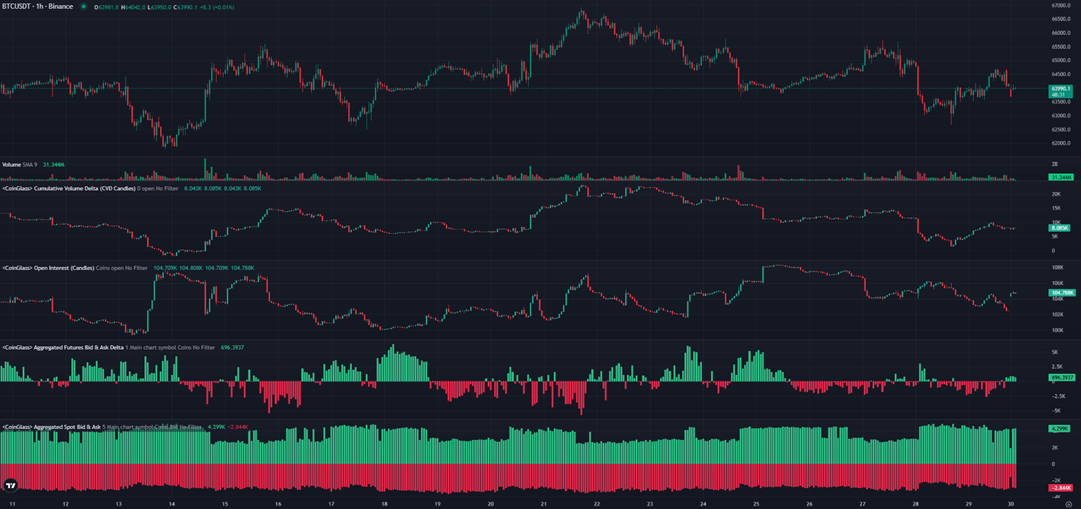
Chart source: CoinGlass
Asset: BTC/USDT
Timeframe: 1H
Metric: Cumulative Volume Delta, Open Interest, Aggregated futures and spot bid/ask delta
Data checked: July 30, 2026, 09:00 UTC
Bitcoin's order book delta is once again showing a typical range-bound pattern: buyers become more dominant as price approaches the lower end of the range, while the balance shifts toward sellers as price reaches or approaches the upper boundary. At present, sell-side liquidity dominates within 5% market depth on the spot market, which is also reflected in the order book delta. However, it is important to consider the support sitting outside this depth: large buy orders are currently concentrated around $61,300.
At the same time, cumulative volume delta is rising while open interest has been declining. This suggests that market liquidity is becoming thinner, which is not surprising given that August is historically one of the least liquid months of the year. Combined with the broader risk-off environment, however, this setup creates not only the potential for elevated volatility but also a risk of Bitcoin breaking below its current range and moving toward the underlying support zone, assuming no unexpected economic or geopolitical developments occur.
Oil prices also remain an important factor. The current decline in oil prices appears fragile, and another upward move could feed into inflation data and accelerate price pressures. In such a scenario, the Federal Reserve may have little choice but to keep rates at their current level or even raise them, a possibility that some banks are already beginning to forecast.
The Fed Decision and Warsh's Hawkish Tone
Chart: US10Y And IEF Comparison
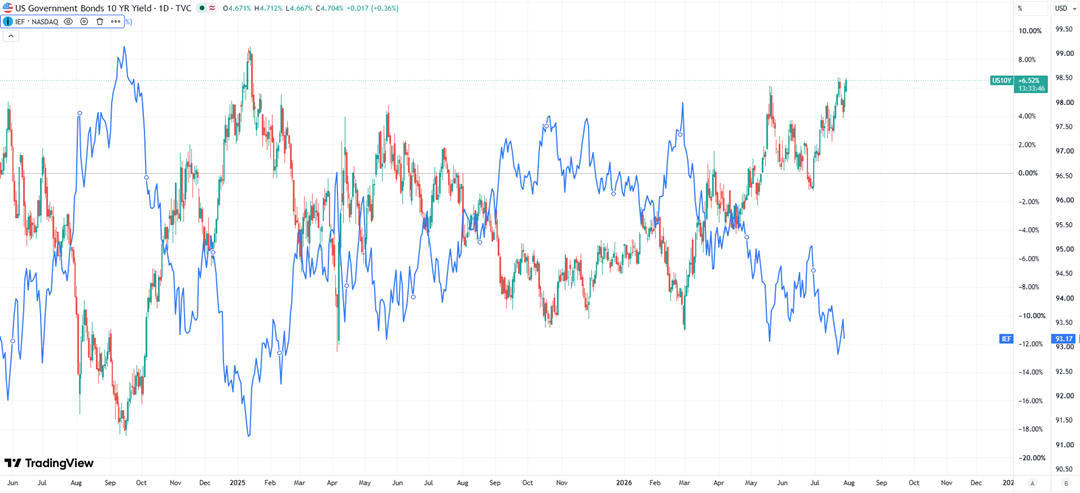
Chart source: TradingView
Asset/market: US 10-Year Treasury Yield, IEF
Timeframe: Daily
Metric: 10Y yield and iShares 7-10 Year Treasury Bond ETF price
Data checked: July 30, 2026, 09:00 UTC
The Federal Reserve kept its policy rate unchanged at 3.50%-3.75%, but the decision was made by a 9-3 majority, with all three dissenting officials voting in favor of a rate hike. The split itself is a hawkish signal. In its statement, the Fed noted that economic activity has been expanding at a solid pace despite elevated uncertainty stemming from the conflict in the Middle East. Productivity growth and capital investment remain strong, while the labor market remains resilient and the unemployment rate has changed little. Inflation, however, remains above the 2% target, partly due to supply shocks in certain sectors, including energy. The Committee reiterated its commitment to maintaining price stability.
At the press conference, Kevin Warsh reinforced the hawkish stance, offering no forward guidance or dovish signals on inflation. The official benchmark remains the PCE price index, but Warsh emphasized that he considers a broader range of economic data. His strongest remark came when he said, “If inflation remains elevated, rate hikes may become part of the solution,” triggering a rise in Treasury yields and a decline in equity indices. He described the sharp increase in Treasury yields and the strengthening dollar as a normal market reaction that the Fed would not seek to counter. For the first time, he also noted that investment in artificial intelligence is contributing to higher infrastructure costs. Previously, AI investment had largely been presented as a purely growth-positive factor, which ties into the AI profitability concerns discussed in our previous edition.
Taken together, the three votes for a rate hike and the Fed's hawkish rhetoric have effectively ruled out a near-term rate cut while keeping the risk of a September hike elevated. This is clearly reflected in the bond market: the yield on 10-year U.S. Treasuries is at its highest level since January 2025, while the price of IEF continues to decline. IEF is an exchange-traded fund tracking 7-10-year U.S. Treasury bonds and therefore serves as a proxy for the price of intermediate-term government debt. The relationship is inverse: as yields rise, bond prices-and consequently IEF-fall.
This matters for crypto markets because higher Treasury yields make risk-free returns more attractive and increase the discount rate applied to future cash flows. This generally creates a headwind for risk assets, including Bitcoin.
Notably, despite the hawkish tone, Warsh did not introduce any major new information. At the same time, he did not add any explicit negative surprises, which helps explain why the crypto market's overall reaction remained relatively neutral.
What to Watch Next
First and foremost, the earnings season is still in focus. Key reports are being released now: Microsoft and Meta on July 29, Apple and Amazon on July 30, as well as Strategy on July 30 after the market close. The market's reaction to these reports will show whether investors continue to reassess Big Tech's AI spending and, consequently, their overall appetite for risk.
The release of U.S. Q2 GDP data is also important, along with further signals from the Federal Reserve and, in particular, the risk of a September rate hike, which is already being reflected in Treasury yields. On the crypto side, investors should monitor progress on the CLARITY Act, a proposed framework for regulating the U.S. crypto market that could have a significant impact on institutional sentiment.
The usual market indicators also remain relevant: order book delta behavior near the boundaries of the current range, the strength of the $61,300 support zone during pullbacks, spot ETF flows, changes in open interest and market liquidity, as well as oil prices and the latest developments involving Iran and the Strait of Hormuz.
Analyst Opinion
Current view: The market remains in a neutral scenario, but with a downside bias. Bitcoin is holding within its current range, but the combination of a broader risk-off environment, a clearly hawkish Federal Reserve, and seasonally thin August liquidity increases the risk of a test of the underlying support zone around $61,300.
Rationale: Bitcoin failed to extend its rally and moved to test support amid weakness in the technology sector, a wave of crypto exchange closures, and expectations of a hawkish Federal Reserve, which were largely confirmed by the July 29 meeting. ETF outflows have resumed, open interest is declining, and market liquidity is thinning. Together, these factors reduce the market's ability to absorb negative surprises. At the same time, the underlying demand structure remains intact: the $62,800 support level held, while a deeper layer of whale buy orders remains below it.
Confirmation level: A return to sustained ETF inflows combined with a move back above $67,000 would revive the case for an upside breakout from the current range. For now, these signals are absent.
Invalidation: A break below $62,800 amid thin liquidity would open the way toward the $61,300 support zone. A breakdown below that level would shift the focus toward a deeper correction. A renewed surge in oil prices, more hawkish Fed rhetoric regarding a September rate hike, or disappointing Big Tech earnings and macroeconomic data could accelerate the downside.
Trading takeaway: In a thin August market, the priority should be risk management and confirmation signals rather than taking a directional bet. The key levels to watch on pullbacks are $62,800 and the $61,300 support zone. On the upside, focus should remain on the market's reaction to earnings, a return of ETF inflows, and incoming macroeconomic data.
In Focus: Regulatory Delays and a VC Winter Squeeze the Altcoin Market
While Bitcoin remains range-bound, the broader altcoin market is going through a difficult period for several reasons. The first is regulatory. Progress on the CLARITY Act, a key piece of U.S. legislation aimed at establishing a framework for the crypto market, has stalled, and market frustration is growing.
The bill is intended to clearly define the respective roles of the SEC and CFTC and provide the industry with a predictable regulatory framework. This is exactly what institutional investors have been waiting for before deploying capital at scale. There has been formal progress: the bill passed the House of Representatives in July 2025 and the Senate Banking Committee in May 2026. However, it has yet to reach a full Senate vote. The target of July 4 was missed, no vote has been scheduled, and the August congressional recess is now becoming the de facto deadline. Key unresolved issues include federal preemption and the final allocation of regulatory oversight between the SEC and CFTC. The bill also needs at least seven Democratic votes to pass. The longer this uncertainty persists, the more cautious institutional capital becomes.
The second factor is a venture capital winter. Crypto venture capital activity has fallen to its lowest level since November 2020. According to CryptoRank data, as of July 28, only 150 venture funds had participated in funding rounds for crypto projects, marking the lowest monthly figure in four years. By comparison, the peak came in March 2022, when 1,177 funds participated. The sharp decline points to further consolidation in the venture capital market: capital is being deployed by a smaller number of funds, while investors are becoming increasingly selective in choosing projects. For the broader altcoin market, this represents a direct constraint: capital that previously flowed into dozens of tokens is now being concentrated in a much smaller number of projects.
The third factor is the wave of project closures, which deserves a more nuanced interpretation. According to RootData, more than 100 crypto projects have announced that they are shutting down since the beginning of 2026, with the trend affecting every layer of the industry, from established exchanges such as BitMEX to DeFi protocols. At first glance, this is concerning, but the process is arguably more constructive than destructive. As noted earlier in this report, some closures are orderly and unrelated to insolvency. At the same time, the process is removing weaker business models and projects without sustainable demand from the market. In this sense, the industry is becoming more mature and resilient.
The broader macroeconomic risk-off environment is also playing a role. During periods of risk aversion, risk assets tend to decline, while the weakest projects may disappear from the market altogether. This can also be viewed as a form of market cleansing, provided that it does not trigger major bankruptcies that pull other projects down with them. The key risk is precisely a domino effect similar to the one seen after the FTX collapse. In its absence, the ongoing consolidation should ultimately make the market more resilient.
Taken together, these factors paint a consistent picture: capital is becoming scarcer and more selective, regulatory clarity is being delayed, and weaker projects are struggling to survive. For a broad-based altcoin rally, this means there is little fuel available in the near term. At the same time, the market is going through a natural maturation process and a flight to quality, which should be constructive for the industry over the long term.
The practical takeaway for investors is straightforward. Right now, it is critical to focus on projects that offer long-term value: those with strong teams and proven track records, credible partnerships, viable business models, and a stable customer base. It is equally important to consider which platform you use, as periods of market consolidation tend to favor resilient and regulated crypto exchanges. During periods of a venture capital winter and regulatory uncertainty, the projects that survive and ultimately outperform are not necessarily the loudest ones, but the most resilient.
Risks for the Week Ahead
- Fragile oil price decline: another surge in oil prices driven by developments involving Iran could accelerate inflation and force the Federal Reserve to keep rates elevated or raise them further.
- A hawkish Federal Reserve: the 9-3 vote, including three votes in favor of a rate hike, combined with Warsh's hawkish rhetoric, effectively rules out a near-term rate cut and keeps the risk of a September hike on the table. Rising Treasury yields remain an indirect channel of pressure on risk assets.
- Continued reassessment of Big Tech's AI spending, amplified by growing competition from China's semiconductor industry following CXMT's IPO.
- Renewed and accelerating outflows from spot Bitcoin and Ethereum ETFs.
- Seasonally thin August liquidity, increasing volatility and the risk of a breakdown below the current trading range.
- Growing concerns surrounding the wave of crypto exchange closures, despite the fact that these shutdowns have been orderly and unrelated to insolvency.
- Disappointing July macroeconomic data.
Watchlist for the Week
- Big Tech earnings: Microsoft and Meta - July 29; Apple and Amazon - July 30.
- Strategy earnings report: July 30, after the market close.
- U.S. Q2 GDP, further Fed guidance, Treasury yields, and the risk of a September rate hike.
- July ISM PMI reports: Monday, August 3, and Wednesday, August 5. These are among the first data points that will provide insight into how the July rise in oil prices has affected inflation. The price components of the indices will be particularly important.
- U.S. labor market data for July: Average Hourly Earnings, Nonfarm Payrolls, and the Unemployment Rate will be released on August 7. These indicators provide key insight into labor market strength and will be important for future Fed rate decisions.
- CLARITY Act: progress on the proposed legislation establishing a regulatory framework for the U.S. crypto market.
- BTC levels: support at $62,800 and the underlying support zone around $61,300; resistance at $67,000-$68,000.
- Order book delta, open interest, and market liquidity: watch for signs of further deterioration in liquidity.
- Spot Bitcoin and Ethereum ETF flows: a return to net inflows would signal a potential shift in market sentiment.
- Brent crude, Iran, and the Strait of Hormuz: monitor signs of further escalation or progress in negotiations mediated by China and Pakistan.
Final Takeaway
Bitcoin spent the week defending its trading range and is currently trading around $64,000. The July 28 test of the $62,800 support level was quickly bought up. Unlike last week, the market did not advance but instead moved into a correction, pressured by a sell-off in Big Tech amid a reassessment of AI spending and growing competition from Chinese semiconductor manufacturers, concerns surrounding the wave of crypto exchange closures, and expectations of a hawkish Federal Reserve.
The July 29 Fed meeting confirmed these expectations. While rates were kept unchanged, the 9-3 vote and Warsh's hawkish tone effectively ruled out a rate cut and kept the possibility of a September hike on the table. Meanwhile, 10-year U.S. Treasury yields rose to their highest levels since January 2025, creating a headwind for risk assets.
ETF outflows have resumed, open interest is declining, and market liquidity is thinning. Against the backdrop of seasonally thin August liquidity, this increases both volatility and the risk of a move toward the underlying support zone around $61,300.
For now, the underlying demand structure remains intact, but a meaningful shift in the market setup would require an external positive catalyst, such as stronger-than-expected earnings, de-escalation in Iran-related tensions, or a less hawkish Federal Reserve. Until then, the priority should remain on confirmation signals and disciplined risk management.
Methodology
This weekly update analyzes crypto market structure, technical indicators, liquidity and market depth, derivatives positioning, options and liquidation data, on-chain activity, and market sentiment alongside asset price performance. It also incorporates relevant macroeconomic, corporate, and regulatory developments. The analysis is based on information available at the time of publication and may change as new market data emerges.
Disclaimer
This report is provided for educational and informational purposes only and should not be considered financial, investment, or trading advice. Cryptocurrency markets are highly volatile, and past performance is not indicative of future results. Always conduct your own research and carefully assess your risk tolerance before making any investment or trading decisions.



.png)